
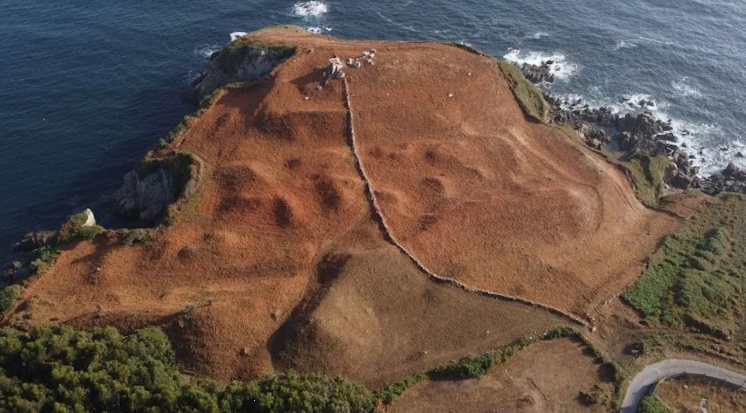
We know there is a castro over on the headland and some non-invasive excavations were undertaken in 2022. Each lump in the photo below is believed to have been a house.
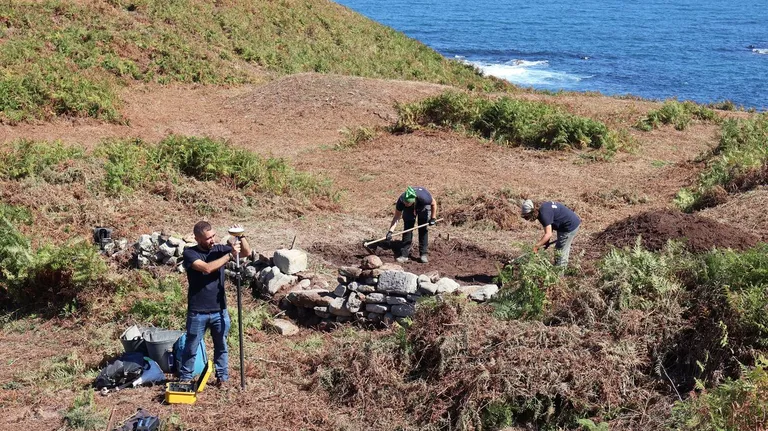
Last week some archaeologists undertook an excavation of a 3×3 meter square and they had an open afternoon for people to see what they were doing.
We can see the headland from the house – so of course were interested to know what they were finding. This is also where we watched the eclipse and sometimes sit on the big stones at the back of the photo above.
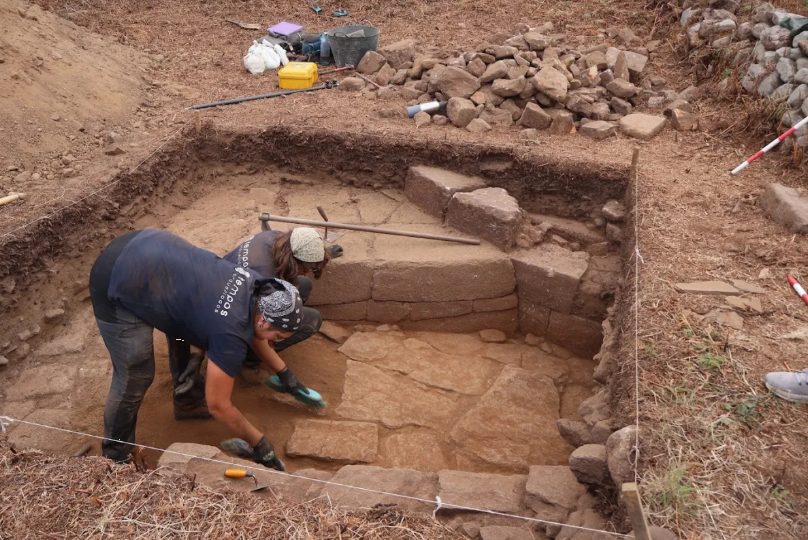
It appears that they found some quite interesting things – including what might have been a road which was unexpected. I’m not sure what will happen next as I don’t think there’s funding for a full excavation – or perhaps the unexpected findings in this mini-excavation will open doors for more excavation work.
This is a translation from an article in the newspaper which will tell all about it better than I can 🙂 Our castro is ‘Rueta’ which is mentioned towards the end:
Rethinking Galicia’s Past: How Coastal Hillforts Challenge Local History
To understand recent archaeological discoveries in Galicia, it helps to know a bit about its ancient inhabitants.
Long before the Romans arrived, the region was home to the Castro culture (roughly 1000 BC to 100 AD). People of this era lived in castros—fortified, walled villages usually built on hilltops. These settlements typically featured stone circular houses and were thought to be self-contained communities where locals farmed, raised livestock, and worked with metals.
Castros settlements were:
- Location and Defense: They were strategically situated on hilltops or coastal promontories. Their main defense was a thick stone wall (muralla) encircling the settlement, often reinforced by a ditch (foxo) and earthen rampart . The wall was not just defensive but also served as a territorial and identity marker .
- Layout: The core of a castro was the croa, usually an elliptical or circular enclosure. Some larger sites had outer extensions called antecastros. Access to the croa was deliberately difficult, via ramps or steps .
- Buildings: The typical dwelling was a circular or oval stone hut with a conical thatched roof. Inside, there was usually a central hearth, a stone bench, and a dirt floor. Smaller, square structures with raised wooden floors served as granaries or storage to protect goods from humidity . Buildings were often separated by small spaces used as corrals or dumps .
- Society and Economy: The economy was largely self-sufficient, based on agriculture, livestock, and metallurgy. While traditionally linked to the Celts, modern scholarship views Castro Culture as an indigenous development with some Celtic influences, rather than a result of mass invasion. Society appears to have been relatively peaceful, with little archaeological evidence of widespread violence or destruction .
For generations, historians believed these ancient Galicians were primarily inland creatures who turned their backs on the sea, despite living on an extensive coastline. However, new archaeological work along the Northern (Cantabrian) coast is completely overturning that theory.
Key Discoveries Changing the Narrative
Recent excavations at coastal castros—such as Castro de Fazouro, Castro de Cabo Blanco, and most recently Castro de Rueta—have revealed that these sea-facing settlements were not isolated farming hamlets, but bustling maritime hubs.
- A Strategic View of the Sea: Unlike inland hillforts designed to overlook valleys and crops, these coastal forts were positioned specifically to monitor sea routes, navigate treacherous shores, and control local bays.
- Seafarers and Traders: Excavations have uncovered fishing tools, fish processing areas, and imported trade goods. Far from fearing the ocean, these communities were active sailors who traded along the Atlantic coast, connecting Galicia with other ancient European cultures.
- Unique Architecture: Rather than following standard inland layouts, these coastal forts adapted to cliffside environments, featuring thick defense walls facing the land and open access to natural harbors.
Spotlight: The Latest Findings at Castro de Rueta (Cervo)
The Castro de Rueta, located right on a coastal headland in the municipality of Cervo, provides a prime example of this ongoing research.
Initial ground-penetrating radar surveys in 2022 suggested the presence of underground structures, including what appeared to be a cluster of around 12 ancient roundhouses and a potential sauna or metallurgical furnace near the village entrance.
In September 2026, archaeologists conducted targeted excavations at Rueta that uncovered surprising, remarkably well-preserved features:
- Paved Stone Streets: Excavations revealed a paved stone roadway (enlousado) running through the site—a sophisticated urban feature rarely seen in such pristine condition in coastal hillforts.
- Massive Stone Structures: The team uncovered unusually large, thick stone walls and the remains of a roundhouse with a preserved doorway. The sheer scale and quality of the stonework have surprised researchers, showing a level of architectural sophistication rarely documented on this part of the coast.
- Iron Age Ceramics: Archaeologists recovered native Iron Age pottery fragments, including wheel-thrown pottery pieces that suggest early trade or contact with Roman influence.
Why This Matters Today
For decades, local history books portrayed ancient Galician society as isolated and purely agricultural. This new research proves that Galicia’s deep relationship with the ocean goes back thousands of years further than previously thought.
Instead of being the “end of the world” (as the Romans later called it), the Galician coast was a thriving gateway for Atlantic trade, cultural exchange, and maritime life.